We left Labuan Bajo with some misgivings about our patched up
gearbox. The engine sounded noisier and there were more vibrations
and rattles. So we motored off with less revs than normal and
puttered along slowly. We passed Gili Lawa Laut on the north side of
Komodo Island, a spot famed for some of the best diving and
snorkeling in the world. We were now in a tourist zone and the area
had many dive charter boats dotted about from the swish to shabby
depending on the tourist's budget.
We were 5 days behind schedule owing to gearbox repairs so
reluctantly we gave stopping at Gili Lawa Laut a miss. We can go back
there next year. We saw a rally boat Allure on the AIS and we chatted
briefly on the radio - Patrick had offered to help if our gearbox
didn't hold out and it was comforting to know that we had someone to
call if only for the morning. Shortly thereafter the wind picked up
and we touched 8 knots speed. Allure was doing a longer distance
requiring an all night sail and we separated near Gili Banta in the
early afternoon. We had heard reports of the Gili Banta north bay
being rolly so we picked a bay on the north east side. And what a
find it was! A little tricky to ease through the gap in the reef to a
crystal clear shallow spot.
The north east bay had the best reef we have ever seen - lovely
corals and many varieties of fish from tiny little bright blue fish
to bigger spotty coral trout. It was great fun snorkeling amongst so
many fish. It's still part of the national park and has escaped being
fished out - for now.
There were some strong bullets of wind during the night but we were
secure and protected. The next morning we sat on the deck for
breakfast and saw some fins circling nearby and presumed it was reef
sharks coming in with the tide. I got so excited standing at the bow
as we moved off and a manta ray lazily swam across the bow. So that's
who the fins belonged to!
It was a short sail the next morning to the village of Were along a
spectacular coastline.
We would have liked to do a longer distance to make up for lost time
but it would have meant arriving in the dark at our next anchorage
and we were in fish traps country - hard to see even in daylight. We
were also in volcano country and we could see the volcano Sangeang
smoking as we got closer. Some dolphins played on our bow and it was
quite a sight - dolphins and a smoking volcano!
We anchored at Were and were immediately besieged by lots of young
visitors in dugouts asking for handouts. The first to arrive had a
very leaky dugout and there was continuous frantic bailing with a
plastic cup. We gave away the last of the biscuits and chocolates
(not Robert's prized stash) much to the disappointment of those that
came after who were particularly wanting Coca Cola or Fanta.
Although Were is a small village, it's known for building traditional
pinisi boats and there were 4 being built on the beach. Robert went
ashore to check them out.
Were village is typical of villages in Indonesia. As we moved
westwards the inhabitants become more Muslim. Eastwards is more
Christian but all along the way, churches and mosques are side by
side, with mosques dominating westwards, seemingly at every anchorage
with huge loudspeakers for calls to prayer. We never woke up later
than 4.30 a.m. at any village.
Robert bought some fresh tomatoes and a hand woven cloth still woven
in the traditional way at outside a home.
The villages use a lot of bamboo in construction. Even in bigger
towns we see bamboo scaffolding going up several floors.
Robert also met the resident volcanologist who is there to monitor
the active volcano. He is from Java and had been stationed at Were
for 3 years (poor fellow). He was super keen to chat to someone in
English about the volcano. There are about 60 active volcanoes in the
area!
Walking on the shore always brings out several people wanting their
photo taken with the visitor.
The next leg across the top of Sumbawa past the Bay of Bima is
notorious for "intense fishing activity" which means lots
of FAD's (Fish Aggregating Device), lone fishermen in small boats and
nets all over.
Some of our rally participants described the area as a minefield of
FAD's and one of the boats caught on a net a few days before. So we
made a detour further out to sea to avoid the worst congestion of
fishing but even so we dodged quite a few FAD's like this one:
We had almost got past most of the fishing activity when we saw a
flag bobbing on a buoy which usually means a net stretched out to a
small boat. We scanned the area around and couldn't see a boat or the
tell tale signs of float bobbles on the surface. No way to tell which
way the net stretched out if there was one. We motored along slowly
and at the last minute I saw the net just below the surface stretched
across our bow. It didn't have the usual floats, just small rounds of
plywood below the waterline. I shouted out to Robert who immediately
killed the engine and turned away but the momentum carried us over
the net and it caught on the prop. Damn! He took down the mainsail,
tied himself on to the boat and went in the water with goggles and
snorkel. Luckily the prop must have stopped as we drifted over the
net and it wasn't too twisted. He cut it off and climbed back on via
the kayak and off we went. The only boat we could see was way off in
the distance, surely too far for the net - who knows.
Our arrival in Kilo was enthusiastically received by the usual
dugouts of children ranging from about 3 years to young teenagers.
There were 3 pretty girls in their teens who asked for lipstick, nail
polish and earrings. Teenage girls all over the world have the same
requirements. The girls sat on our boat and inspected our coral shoes
with much giggling.
Two big catamarans arrived shortly afterwards and the children lost
interest in our boring boat and headed for the new arrivals who were
better stocked and handed out some items.
We escaped to the shore for a walk but hadn't gone far when a young
man ran up behind us. He is Udin and the self-appointed English
teacher. He taught himself English from Facebook and uses every
opportunity to practice it with passing tourists. He seemed to have a
fair knowledge of cities around the world and we were surprised to
find out that not only did he know all the major cities in South
Africa but he also knew that Macassar in Cape Town was named after
Makassar in Sulawesi and originally had some Indonesian settlers who
are now integrated with "the natives". I googled afterwards
and he was right! An interesting tale for other Googlers. We got to
know a lot more about Udin in the short walk including his recent
second marriage and hobby of collecting foreign banknotes. We
presented him with a vacuum flask for his new wife, a donation to his
English class and R20 which delighted him as it had his hero on it,
Nelson Mandela.
By the time we got back to our boat, the children had congregated on
one of catamarans, the music was turned up very loud and an
Australian lady was teaching them Gangnam Style on deck. It became so
festive that the sounds of the muezzin through loudspeakers was
barely heard over Abba. Eventually the parents stood on shore waving
for the kids to come home and peace settled on the anchorage.
The muezzin got his comeback at 4.30 a.m. the next morning - a very
loud, shock awakening screech of a vuvuzela. Or he had a very
scratchy morning voice. Either way the sound through loudspeakers was
horrendous. All the lights came on in the boats and most of us lifted
the anchors early.
The wind picked up in the late morning and we had a breath taking
ride of 12,2 knots on a swell. Robert took in some sail and we
continued to Kananga with strong wind.
We anchored in a bouncy chop with 3 other boats from a different
rally soon to be combined. We went ashore to a black beach for a walk
and amazingly the black beach sand was quite soft. Volcano
sand.
We met Boodi, a home style shop keeper who said he could provide
fruit and vegetables. Robert and a couple from another boat went off
with Boodi. It turned out his home style shop was where he wrote down
our orders, went on scooter to the next town half an hour away and
quoted ridiculous prices. It was all declined and the prospective
customers returned to their boats. We were having a late supper when
we saw a light approaching our boat and someone calling in the
darkness. It was Boodi on a small outrigger with mangoes, watermelons
and pineapples. He presented his invoice. The prices had dropped
drastically and we duly paid for everything. Ekeing out a living here
is sometimes desperate and Boodi was enterprising.
The next hop was to the island Moyo, passing various pinisi boats
along the way.
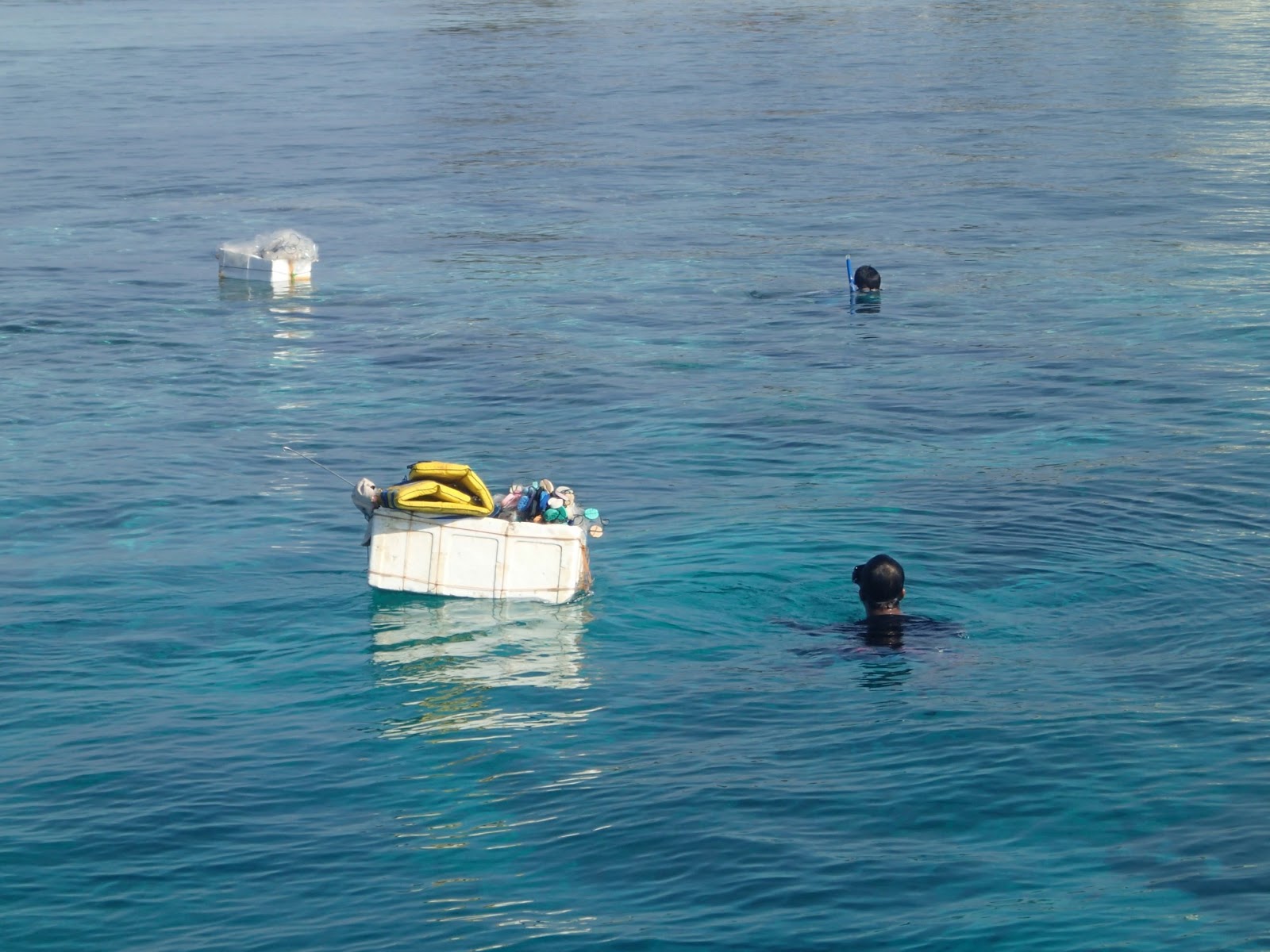
We saw dolphins chasing fish. They group together in a tight circle
driving the fish into the circle.
The western bay on Moyo is a difficult anchorage as it is very deep
and the coral extends outwards from the shoreline. The only place
where we couldn't get ashore. It took 3 attempts to find a sandy spot
that wasn't too deep, a nearby fisherman got into his dugout and
paddled over to indicate a coral free sandy bottom. We anchored in
19m. The fisherman's name is Rio and he asked if we like lobster. We
said yes and wondered what this was going to cost. He came back with
2 lobsters and asked if he could climb onboard. He refused to take
payment and instead asked if we had glue to fix his wetsuit. Robert
scratched around and the only glue sort of suitable was for tent
repair. Rio seemed happy with that and then mentioned his leaky
goggles ("masker"). We've been asked for a "masker"
so many times but we don't have spare. On the one hand I felt bad
that we couldn't give him one as he helped us with anchoring and gave
us lobsters. On the other hand, more masks mean less chance for the
smaller reef fish to escape capture before reaching maturity. There
are hardly any big fish left on the reefs we've seen.
Moyo island also happens to have the world's most expensive dive
resort in a corner of the bay. Dinner at the resort costs USD 130 per
person and has to be pre-booked. Stuff them, we have lobster.
Most of the rally boats had congregated in Badas where all kinds of
festivals and tours had been arranged for the participants over 5
days. However, we had just caught up on our 5 days behind schedule
and we were deciding between more tours to villages, dancing girls,
weaving and speeches - or swimming peacefully in warm water and a
sleep in without mosques. Swimming off an island won and we set off
for Pulau Kramat, an island on the north west side of Sumbawa.
We found a deserted quaint wooden building on the beach, with planted
banana and coconut trees in the background. A dilapidated jetty and
delightful clear swimming area in the front. There were pathways,
bridges, fountain stands and shady purpose built areas - all
derelict. How intriguing, what a magnificent setting! I tried to
persuade Robert this is the fixer-upper of my dreams.
We saw a small fishing boat circling madly with a net. A very excited
crew pulled in a haul of large sized fish. That's a rarity here where
most places are so fished out that the locals almost resort to
catching Nemo in very fine nets. The fishing boat pulled up to the
beach to sort out their net. They were clearly very pleased with
being in the right spot at the right time. Robert went closer for a
look and offered to buy a fish. They gave him one and didn't want
payment. How nice is that! We have enough fish for two dinners which
is great as our provisions are low.
The next morning's sail from Pulau Kramat to Gili Lawang across the
north of Alas Strait was the worst we have experienced so far. The
wind unexpectedly quickly reached 30 knots from the front and the
steep swells became waves crashing into the front of the boat and
shooting water into the cockpit. We had clipped on in the cockpit and
were sitting ducks literally as the water sprayed in continually and
drenched us. At one point the rope from the front sail's roller
furler snapped loose and Robert had the unenviable task of crawling
to the bow and manually dragging down the sail into the toilet hatch
while waves bashed him. Six hours of sheer hell and a green looking
Robert and me needing to pee desperately.
There were two other boats ahead of us and it was some comfort to
know that we hadn't got it all wrong and we weren't the only idiots
at sea in this wind. We reached Gili Lawang eventually and it was
calmer behind the high mountains. We anchored off the island
surrounded by a reef and Robert got to work on the roller furler. 4
hours later the wind direction changed completely and pushed Pegasos
almost 100m back - too close to the reef. We dropped everything
(including a part of the roller furler that fell into the sea),
gunned the engine and fought our way across bouncy waves to the shore
on the mainland. It was a windy night with gusts up to 28 knots at
anchor.
The wind died down in the early hours of the morning and gave us a
chance to put the front sail back up. Bizarrely after yesterday's
gale-force wind, there was none today and we motored the whole way to
Amoramor.
We went ashore for a walk and the damage from the previous month's
strong earthquakes in this area were all around. Many people have
lost their homes and are living in makeshift tents. The more remote
villages are without water and sanitation.
We found a café selling snacks and drinks with a small viewpoint. We
had our coffee served the traditional way - black and sweet in small
glasses, usually with a flower pattern.
Back on the boat for sundowners we discovered that the village of
Amoramor must have at least 4 mosques seemingly in competition with
each other. The wailing through powerful loudspeakers carried on for
2 hours, one of them had a young child wailing discordantly on and
on. It started again at 4.30 am for another 2 hours. Unbelievably
loud and irritating. No wonder the place is not mentioned as an
anchorage in the Sail to Indonesia notes.
It was a short hop to Medana Bay in the calm morning. It seems to be
a weather pattern of a few hours of early morning calm and gales the
rest of the day. We anchored close to Medana Bay Marina where the
yachts from 2 different rallies were starting to join up. It was a
tight place for anchoring with so many yachts.
We went ashore to buy data - usually a long winded affair of much
button tapping by the seller. In Indonesia one can't buy data online
without an Indonesian bank account and the various confusing packages
are designed to provide minimal GB internet data and lots of GB for
unwanted items for videomax, chat, etc. On the way we saw much more
evidence of how serious the earthquakes were.
Robert was intrigued by this structure, a geodesic dome built in bamboo
As the boats started arriving in Medana Bay, there were plans being
made by the yachties for fund raising, food supplies and assistance
for the local people who had lost their homes and schools. It was good to see familiar faces and boats however
briefly.
Our next stop was just an hour away at one of three islands close
together known as the Gili islands. We picked up a mooring buoy at
Gili Air and immediately noticed some fishermen standing on the reef
fishing with very fine nets. The fish they caught were minute. It's
quite distressing to see the extent of over fishing on reefs, as well
as the damage caused to the reefs.
We dinghied around to the east side of the small island which is
supposed to have good coral. There were even more fishing boats on
these reefs. We snorkeled a couple of spots and were disappointed.
The reefs are damaged, the coral is mostly dead and there were very
few fish. It's clear from the island's infrastructure that this is a
heavily touristed area for diving and snorkeling - a source of much
needed revenue for the locals so it's such a pity to destroy the big
draw card for the tourist revenue. The main waterfront area has its
own charm with quaint shops and bicycles or pony carts for transport
- cars are not allowed on the Gili islands. Here too the destruction
caused by the earthquakes is everywhere and most of the shops and
restaurants were still closed with very few visitors around.
We decided to visit Gili Trawangan as it's so close by. We picked up
a mooring buoy and had a quick swim off the boat. We went ashore for
lunch and to walk along the waterfront area. This is more of a vibey
island with the tourists being mainly young backpackers wanting to
enjoy the diving experience. There are more dive shops than anything
else in Gili Trawangan, every business seems to offer a diving trip.
The damage caused by last month's earthquakes is very severe with
nearly every building cracked and broken including the mosque with
its minaret leaning over nearby homes.
Our last sail of this season turned out to test our endurance and was
probably the most memorable for all the wrong reasons. We left Gili
Trawangan early for what was supposed to be a short sail southwards
to Gili Gede. The sea was choppy and the wind from the wrong
direction so we couldn't use our sails and we bounced along making
slow progress with the engine revs going as much as we dared not
wanting to push the repaired gearbox.
About 2 hours later our prop caught on something and the engine
screeched to a halt. We were too close to shore with the wind pushing
up swells to sort it out on the spot so Robert lifted a sail and
sailed off our route into the open sea. Along the way we had noticed
hundreds of small outriggers with a sail tearing along downwind in
our direction. A couple seemed about to crash into us as we shouted
and veered off course to avoid collision. There were hundreds more
stretched off into the horizon all maximising the wind at high speed.
It was tedious dodging through the kamikaze avalanche of outriggers
for over an hour.
Eventually the wind dropped and the sea calmed down. We stopped and
launched the kayak and Robert dived under the boat to check the prop.
He came up with a large plastic woven mat. There is so much rubbish
in this sea, it was inevitable that it would happen.
Back on the boat Robert switched on the engine. Oh no! The gearbox
isn't working properly, in fact it's barely making 1 knot at a push.
It seems the strain on the prop with the plastic mat was too much for
the gearbox and broke the recently repaired coupling - the Labuan
Bajo workshop job that Robert was most apprehensive about turned out
to be not good enough.
The wind dropped even more so up went all the sails and Robert tacked
making the most of what wind there was hoping it would last. About
two thirds of the way from our destination at Gili Gede there was a
strange whooshing sound in the air. Suddenly out of nowhere we got
blasted with a very strong wind from a completely different
direction. Robert quickly changed sail angle and Pegasos took off
doing over 7 knots. Unfortunately not in a sustainable direction so
we were forced to tack again, this time in wind over 20 knots.
We zig zagged along keeping constant watch for moving ships as we
were now crossing a busy shipping lane. Our zig zag got tighter as we
entered a narrow channel with reefs on either side using an
inaccurate chart. This was a steep learning curve for me as the pace
in the narrow channel was too fast for Robert to tack on his own. I
hopped from one side to the other releasing ropes as he called out
while the wind still blasted.
We got as close as we could to Marina Del Ray which was still out of
sight around a corner, headed as close as we dared to a shore and
dropped the anchor. Robert pulled in the sails and there we were - a
little stuck to make the last few 100 metres as we couldn't see
around the corner and didn't want to go barreling into expensive
yachts moored at the marina. Or even cheap yachts for that matter.
Robert set off in the dinghy around the corner to see the marina.
After a while, he came back with 3 guys in a power boat belonging to
the marina and they towed Pegasos around the corner to a mooring
buoy. So our last leg didn't end with a flourish, more like a fizzle.
We didn't care. We made it through a series of odds and we are now so
hot at tacking!
We spent about a week packing up the boat, dissembling bits and
storing away. It was very hot and at lunchtimes we took a break and
went ashore for lunch at a nearby fishing village.
Goodbye Pegasos, we're back next year!